Gayatri Mantra - Meaning, Benefits and How to Chant It Correctly
By Atmik Scholars | 31st May 2026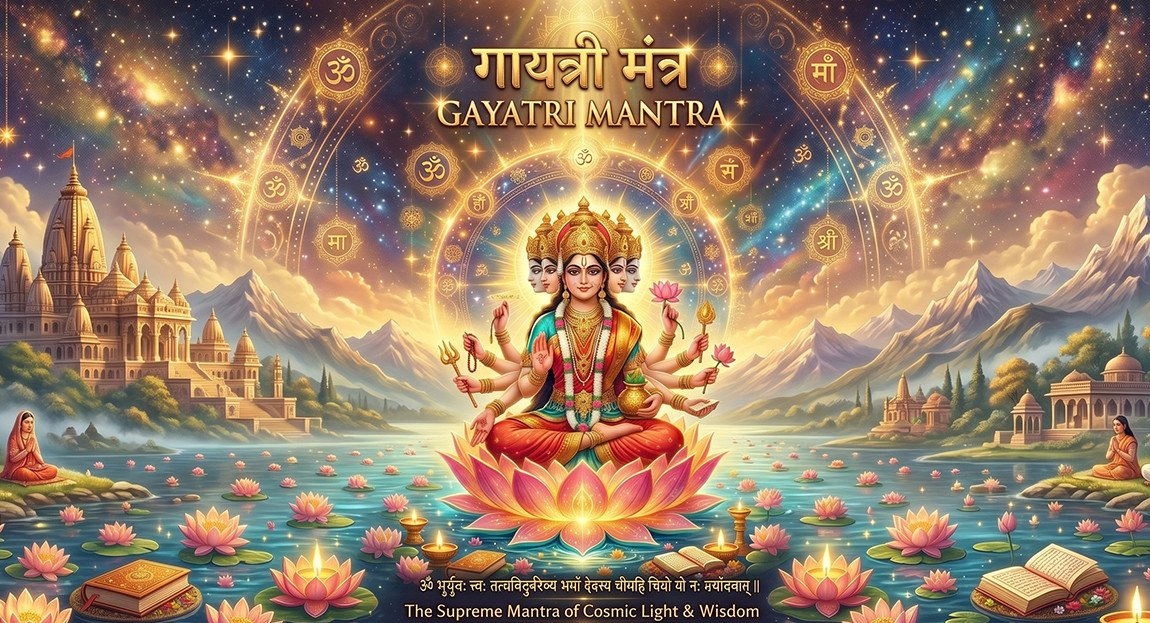
Gayatri Mantra - Meaning, Benefits and How to Chant It Correctly
By the Atmik Team · Reviewed by Sanskrit scholars · Reading time: 8 minutes
There is a good chance you have heard the Gayatri Mantra before at a school assembly, during a puja at home, or played softly in the background of a yoga class. But if you were asked to explain what it actually means, word by word, you might pause.
You are not alone. Millions of people chant one of the most powerful mantras in the Hindu tradition every single day without knowing what they are saying. This article changes that.
We will walk through the full meaning of every word, the science behind why chanting it works, the right way to practice it, and why this 3,500-year-old mantra is perhaps more relevant to modern life than any motivational quote you will find today.
What Is the Gayatri Mantra?
The Gayatri Mantra is a Vedic hymn found in the Rigveda (Mandala 3, Hymn 62, Verse 10), one of the oldest scriptures in human history. It is addressed to Savitri, the solar deity the divine light of the sun and is considered the essence of all Vedic knowledge.
The sage Vishwamitra is credited with receiving and transmitting this mantra. In Hindu tradition, the Gayatri Mantra is not just a prayer it is a guru mantra, recited during the sacred thread ceremony (Upanayana) and traditionally practised as the foundation of a student's spiritual education.
In Sanskrit, "Gayatri" refers to a specific Vedic metre 24 syllables arranged in three lines of 8. That structure is not incidental. The rhythm itself is said to carry the vibration of the mantra's meaning.
The Full Text
In Devanagari
ॐ भूर्भुवः स्वः
तत्सवितुर्वरेण्यं
भर्गो देवस्य धीमहि
धियो यो नः प्रचोदयात्
In EnglishTransliteration
Om Bhur Bhuvah Swaha
Tat Savitur Varenyam
Bhargo Devasya Dhimahi
Dhiyo Yo Nah Prachodayat
Audio Pronunciation
Listen to the full Gayatri Mantra with slow, segment-by-segment guidance on the Atmik app available free on Android and iOS.
Word-by-Word Meaning
Understanding the Gayatri Mantra requires going deeper than a single translated sentence. Here is every word explained:
| Sanskrit | Meaning |
|---|---|
| Om | The primordial sound the vibration from which all creation emerged |
| Bhur | The physical world the earth plane, the body |
| Bhuvah | The subtle world the life force, the breath |
| Swaha | The celestial world the realm of thought and spirit |
| Tat | That referring to the divine reality beyond name and form |
| Savitur | Of the sun the divine solar deity Savitri, source of all light |
| Varenyam | Most worthy of worship, most excellent, most adorable |
| Bhargo | The radiance, the divine light, the spiritual splendour |
| Devasya | Of the divine, of the god |
| Dhimahi | We meditate upon, we contemplate |
| Dhiyo | Intellect, understanding, wisdom |
| Yo | Who, which |
| Nah | Our |
| Prachodayat | May inspire, may illuminate, may direct |
What the Mantra Is Actually Saying
A direct translation reads something like: "We meditate upon the radiant divine light of the sun. May that divine light illuminate and inspire our intellect."
But the meaning runs deeper than any English sentence can capture.
The three words Bhur, Bhuvah, Swaha represent three planes of existence the physical, the vital and the mental. The mantra begins by acknowledging all three, grounding the practitioner in the fullness of reality before making the request.
The request itself is striking in its simplicity. After 3,500 years, the prayer is not for wealth, victory or long life. It is a request for one thing: illuminated intelligence. The ability to think clearly, perceive truthfully and act wisely.
This is not coincidental. The Vedic seers understood something that modern neuroscience is only beginning to explore that the quality of our perception determines the quality of our life. If the mind is clear, every other problem becomes solvable. If the mind is clouded, no external resource is sufficient.
The Gayatri Mantra is, in essence, a daily practice of asking for clarity.
The Science Behind Chanting the Gayatri Mantra
It is tempting to treat mantras as purely spiritual but the evidence for their physiological effects is substantial and growing.
Brainwave changes: Research published in the International Journal of Yoga found that regular mantra chanting increases alpha wave activity in the brain the state associated with calm focus, creative thinking and reduced anxiety. This is the mental state students need most during study.
Vagal nerve stimulation: The rhythmic, controlled breathing required for chanting activates the vagus nerve, which regulates the parasympathetic nervous system. In plain terms: it reduces the stress response and shifts the body out of fight-or-flight mode.
Sanskrit phonetics: Neurolinguists have noted that the specific sounds of Sanskrit the retroflex consonants, the nasals, the long vowels engage parts of the brain linked to memory consolidation. The 24-syllable structure of the Gayatri creates a specific neurological rhythm when chanted correctly.
Memory and concentration: A 2017 study by NIMHANS (National Institute of Mental Health and Neurosciences, Bengaluru) found that children who practised Vedic chanting for 45 minutes daily showed significantly improved working memory and attention span compared to a control group.
None of this contradicts the spiritual dimension of the mantra. It simply confirms that the ancients built something that works on every level.
Benefits of Chanting the Gayatri Mantra
Based on both classical texts and contemporary research, regular practice of the Gayatri Mantra is associated with:
For students:
- Improved concentration and memory retention
- Reduced exam anxiety
- Better sleep quality (when chanted in the evening)
- Increased mental clarity before study sessions
For adults:
- Stress reduction and emotional regulation
- A sense of grounded calm during high-pressure situations
- Improved breathing patterns and lung capacity
- Deeper connection to one's cultural and spiritual heritage
For children:
- Vocabulary development and phonemic awareness
- Introduction to Sanskrit sounds and rhythm
- A positive morning routine that builds discipline
- Cultural identity and a sense of belonging
When and How to Chant the Gayatri Mantra
The ideal times
Classical texts prescribe three times for Gayatri practice, called the three Sandhyas the junctions between night and day:
- Brahma Muhurta (approximately 4:30 to 6:00 AM) the most auspicious time, when the mind is still and the air is clean
- Madhyanha (noon) a brief midday practice, often just 3 repetitions
- Sayam Sandhya (sunset) the evening practice, a moment of reflection at the day's end
For beginners and students, a simple morning practice before school or breakfast is entirely sufficient.
How many times to chant
The traditional prescription is 108 repetitions using a japa mala (prayer beads). However, for children and beginners, even 3 to 11 repetitions done with full attention and correct pronunciation carry significant benefit.
The principle is this: quality of attention always outweighs quantity of repetition.
Sitting position
Sit comfortably with your spine straight on the floor, on a chair, or in Sukhasana (cross-legged). Face east in the morning, north in the evening. Keep your eyes gently closed.
Breathing
Inhale before beginning each repetition. The mantra is chanted on a single extended exhale where possible, or naturally broken across the breath. Do not rush. The rhythm matters.
Pronunciation guide
The most common mistake is treating it like English rushing through and dropping syllables. The Gayatri has 24 precise syllables. Each one should be clear:
- Om hold for 3 counts, let it resonate
- Bhur-Bhu-Vah-Swa-Ha five distinct syllables, even spacing
- Tat-Sa-Vi-Tur-Va-Re-Nyam the "r" is rolled softly, "nyam" rhymes with "yum"
- Bhar-Go-Dev-As-Ya-Dhi-Ma-Hi "dhi" sounds like "dhee"
- Dhi-Yo-Yo-Nah-Pra-Cho-Da-Yat ends softly, the "t" is barely voiced
For guided audio with correct pronunciation, slow-chant mode and segment-by-segment practice, open the Atmik app.
Teaching the Gayatri Mantra to Children
Children learn the Gayatri Mantra most effectively through three things: repetition, rhythm and meaning.
The mistake most parents make is teaching the words before the meaning. A child who understands that they are asking for a clear, bright mind like sunlight clearing morning fog will connect with the practice far more deeply than one who has simply memorised sounds.
A simple explanation for a young child: "We are asking the light of the sun to help make our mind bright and clear, so we can think well and understand things."
For older children and teenagers, the deeper meaning the acknowledgement of three planes of existence, the choice to ask for wisdom rather than wealth can open genuine philosophical conversations.
The Atmik app includes a children's version with slower pronunciation, visual aids and a story-based introduction to the Gayatri. It is designed for ages 6 and above.
A Note for the Modern Practitioner
If you have never chanted a mantra and this feels unfamiliar, that is completely natural. The Gayatri Mantra does not require any specific religious belief to practise. It asks only for one thing a clear, illuminated mind and that is something every human being, regardless of background, can appreciate.
Start with three repetitions tomorrow morning. Notice how you feel before and after. Then decide.
Frequently Asked Questions
Can women chant the Gayatri Mantra? Yes. While certain orthodox traditions historically restricted this, the modern consensus among most Hindu scholars and spiritual teachers including Swami Vivekananda and Sri Aurobindo is that the Gayatri Mantra belongs to all human beings without restriction of gender, caste or background.
Does it need to be chanted aloud or can it be silent? Both are valid. Aloud chanting (Vachika Japa) engages the breath and vocal cords most fully. Silent mental chanting (Manasika Japa) is considered more powerful in classical texts, as it requires deeper concentration. For children and beginners, aloud is recommended.
What if I cannot pronounce it correctly yet? Begin anyway. Correct pronunciation comes with practice. The intention behind the chanting matters as much as the phonetic precision though working toward correct pronunciation is always worthwhile.
Is there a specific deity I am praying to? The Gayatri is addressed to Savitri, the solar divine principle the light that makes all perception possible. It is non-sectarian and does not require the practitioner to worship a specific form.
Explore the Gayatri Mantra on Atmik
The Atmik app includes the complete Gayatri Mantra with:
- Slow, clear audio chanting by trained practitioners
- Segment-by-segment pronunciation guide
- Word-by-word meaning in English
- Guided practice for children (ages 6+)
- Recommended chanting schedule and reminders
Download Atmik on Android · Download Atmik on iOS


Related Articles on Atmik
- Saraswati Vandana and Its Role in Learning
- Shlokas: The Ancient Hack for Modern Student Productivity
- Why Your Child Should Learn Shlokas 7 Science-Backed Benefits (coming soon)
- Hanuman Chalisa Every Verse Explained (coming soon)
Atmik is a scholar-reviewed digital platform for Hindu wisdom, mantras, shlokas and stories. All content is pronunciation-checked and meaning-validated. Download free on Android and iOS.
Related Posts